Prerequisites Make sure your account is on the AI agent plan and you have enough AI credits available in your onWebChat account.
New to onWebChat? Create your account to get started. Get the AI agent (+ Pro) free for your first 14 days, plus 50 AI credits (one AI credit covers one complete conversation with a visitor).
Step 1 Give onWebChat your website address
The first time you log in, onWebChat asks how you plan to use it. Choose the AI chatbot and type the address of your website. That single field starts the whole setup: nothing else is asked of you. If you skipped that question, open AI Chatbot and then Chatbot Settings, where the same field is waiting for you.
While you watch, onWebChat opens your homepage, finds the pages that answer real questions (contact, about, FAQ, shipping, returns, pricing), recognizes the language you write in and reads the rest of your website in the background. A small site is finished in about two minutes. See what happens minute by minute.
Step 2 Review the settings written for you
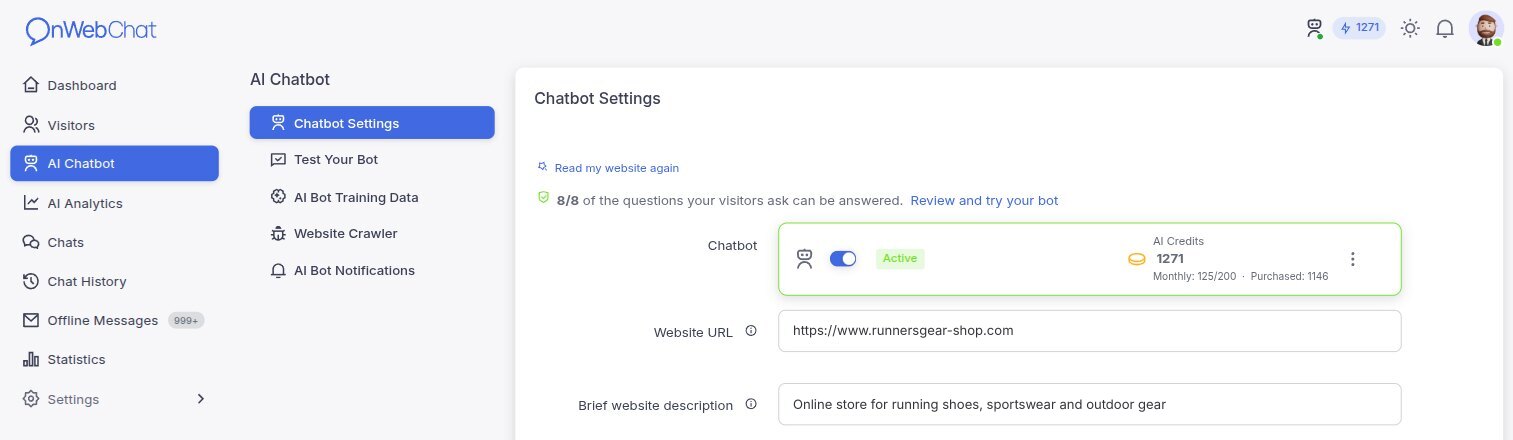
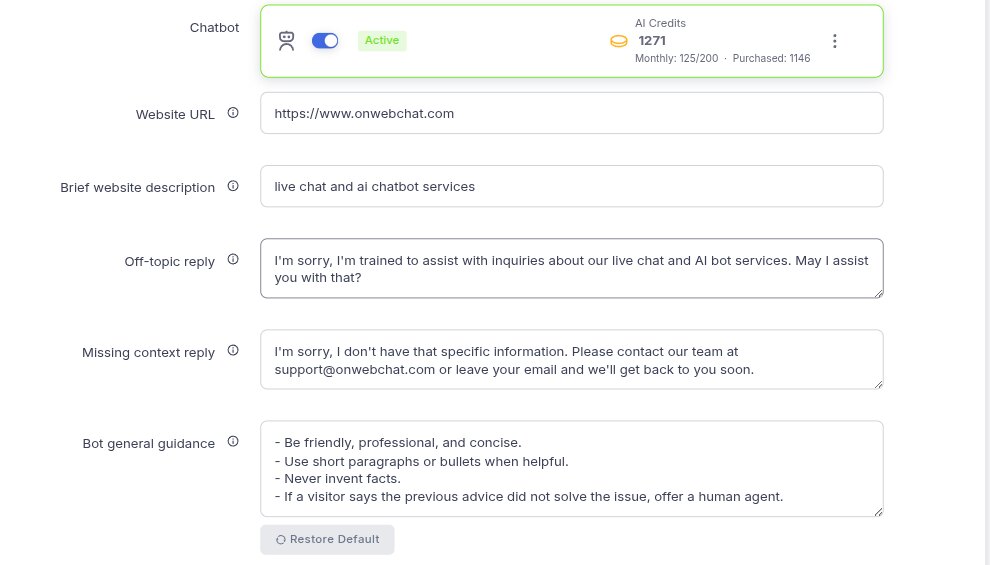
Every field below is filled in from your own pages, in the language of your website. Read them, change whatever does not sound like you, and press Apply:
Website URL: Already filled in with the address you gave. It is the site your bot learns from.
Website Description: A short summary of what your business does, written from your homepage. Your bot is never enabled without one, so check that it describes you well.
Off-Topic Reply: The reply for questions that have nothing to do with your business, generated in your own tone of voice.
Missing Context Reply: The reply for questions about you that your training content does not cover yet. A good one offers the visitor a human instead of an apology.
Bot general guidance: How your bot should behave in every reply: how formal to be, how long an answer should get, when to share a link. The generated guidance already follows the tone of your website, so most people only add a line or two of their own.
Nothing is live until you apply it, and anything you write yourself is never overwritten by a later run.
Step 3 Close the gaps in the readiness checklist
This is the step that decides how good your chatbot is. onWebChat takes the questions your visitors are most likely to ask, tries each one against everything it learned from your website, and shows you a checklist: answered, weak or missing. A gap is usually something your website never actually says out loud, such as your delivery time or whether you have a physical shop.
Best Practice: Answer every gap directly in the checklist, in one or two plain sentences. Each answer you type becomes normal training content, and the question is graded again immediately, so you can see the row turn green.
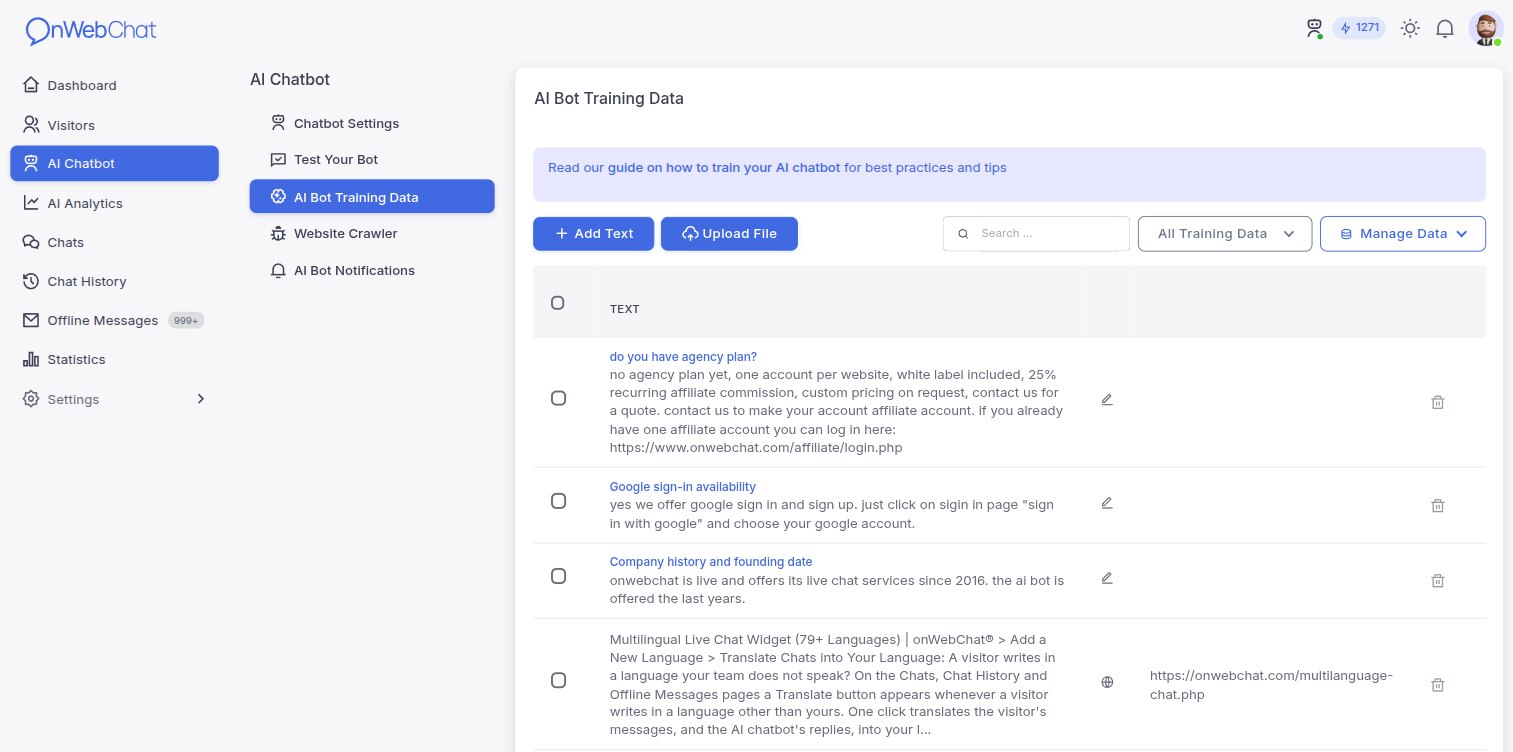
You can always add more training content by hand, from the AI Chatbot Training Data tab:
- Manual text entry: Type or paste anything your website does not explain, as plain text or as question and answer pairs
- File upload: Upload documents, PDFs, or text files containing your business information
- Website crawling: Re-read your whole website whenever it changes, or add single pages that were not crawled the first time
For detailed information about each training method and best practices, read our guide to chatbot training.
Step 4 Test the bot before it goes live
You do not need to publish anything to try your chatbot. Ask it questions straight from the dashboard, exactly the way a customer would, and every answer tells you which page of your website it came from. That makes a wrong answer easy to fix: you go to that page, or you correct the passage it used.
Cover the awkward cases too: a question you do not answer at all, a rude question, a question in another language. These test chats cost no AI credits, and they never appear in your chat history or statistics.
Step 5 Switch it on and keep it improving
Turn the bot on and install the chat widget on your website. From then on you do not have to read the conversations yourself: AI Analytics checks each one about an hour after it ends and shows you what the bot answered, where it failed and what to fix, with a draft answer you apply in one click. A written report is emailed to you every Monday.
If your chatbot misses context or provides weak answers, take these steps:
- Add new training data for repeated customer questions
- Refine your global guidance to better match your brand voice
- Update your fallback message for out-of-scope requests
- Re-run the setup after a redesign, so the checklist grades your new pages
Your website will change too. Whenever it does, run the setup again or crawl the new pages from your dashboard: pages you deleted stop being quoted, and your own edits stay exactly as you left them.